Suddenly this morning when I woke up it struck me, something clicked inside of my mind and it made perfect sense. I am now convinced that Trump is a secret Russian spy whose mission is to destroy the American democracy once and for all. Now that he realizes he will more than likely lose the upcoming election, he is doing his utmost to disrupt society while he still can, by spreading confusion and instigating chaos. He will go to any extreme to disrupt the lives of innocent Americans. Just like other dictators have done in the past, he is willing to take down the rest of the country with his own demise no matter what it takes. Hopefully in the end civilization will survive and life on Earth will become better again.
Category: History
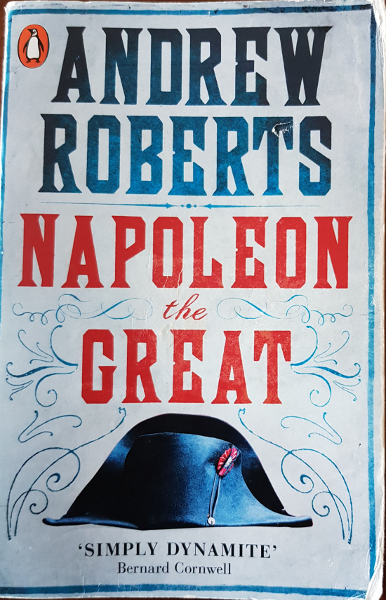
The life and times of Napoleon is a fascinating story. Having nearly completed the book, I have enjoyed learning about his life and accomplishments both good and bad.
Sometimes all of the nitty gritty war details about this and that battle can be cumbersome to read. The who, when and where are time consuming and sometimes a bit boring to read through.
During that period of history, the casualties of war were terrible. Many battles resulted in tens of thousands of deaths, sometimes the majority of fatalities resulting from disease, infections, starvation or even freezing to death.
With less than one hundred pages of the in total eight hundred page book remaining, I have only two chapters to go: Waterloo and St.Helena.
The actual Waterloo battle grounds are not far from where I live, only 180 kilometers, and I will most certainly be making a visit sometime soon to witness the area in person.

It's hard to believe but true, Donald Trump will be the next president of the United States of America. The people have stood up and spoken very loudly and clearly. They demand change and that is what they are going to get. Hopefully. Hillary Clinton gave it all she's worth, but in end she was too old school and unfortunately even less trustworthy than her opponent. Better luck next time, if there is one.
God bless America and hope for the best.
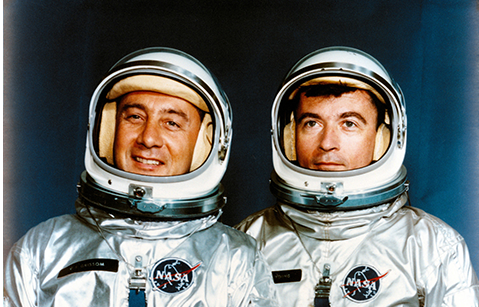
Wow, has it already been fifty years ago since the launch of Gemini III? Those were the very first steps on our way to landing on the moon. For me it seems like it was just yesterday.
Poor Gus Grissom died later in the awful Apollo fire (God bless his soul), but John Young ended up living a very successful life as an astronaut undertaking many more missions (he's now 84 believe or not).
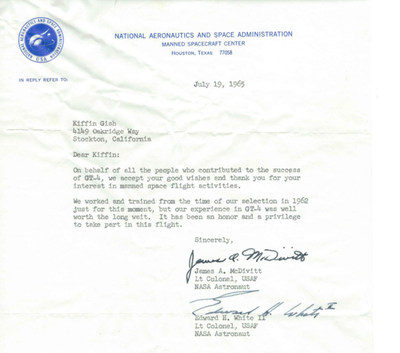
Gemini IV impressed me so much that I drew a picture of the Gemini capsule floating in space above the Earth and sent it to astronauts Ed White and Jim McDivitt. Below the letter they sent back to me:
Some interesting links:
Last week I spent a couple of days in Gladbeck, Germany for some business gathering with our customers and partners. During the late afternoon we formed teams and competed against each other in this geocaching contest.
As we explored the area and zigzagged our way through the dense forest, we came upon this arena-like building in the middle of nowhere. Upon closer inspection, I realized that it was an old and deteriorating monument. To commemorate all those pour souls who had lost their lives in the two world wars. Senseless losses were everywhere to be seen on the walls.
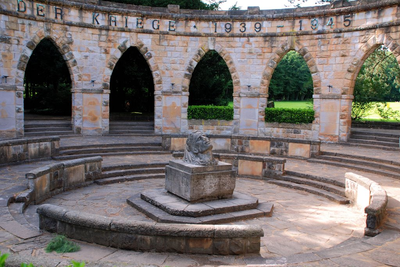
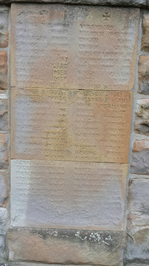
Gedenkstätte für die Toten der Kriege von 1914-1918 und 1939-1945.
No one else in our group seemed to notice. They just went on with the game antics, laughing and shouting. Of course, being one who is sensitive to the surroundings and interested in history, I meandered around and took a closer look. I could see that the monument had been neglected for many years. I mentioned it later to a German person during dinner, and he explained that the Germans were not proud of their past, even embarrassed you could say. That's why such monuments were pretty much ignored, so that one was not reminded about the past too much.
On the walls completely around the whole circumference of this arena thousands of names were inscribed in stone (see picture). The passing of time had meant lots of erosion. Half of the names were faded and illegible, maybe more. That made me very sad. These poor folks had nothing left to give the world except for these inscriptions. As the letters faded away, no one would ever remember them again.
Here is the exact location.
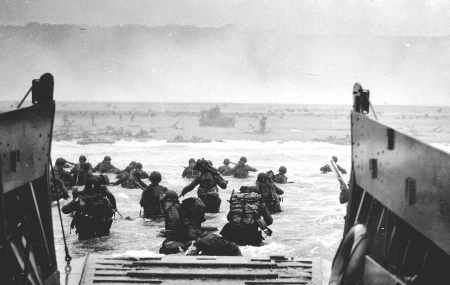
Thousands of brave soldiers sacrificed their lives seventy year ago today. Many more would die before Europe would be liberated from the oppressors.
Whether you want to admit it or not, each and every one of us is in one way or the other an important part of creating never-ending events in world history.
Your immediate surroundings and time frame are both within a powerful sphere of influence.
All thoughts and actions cause a massive avalanche of side effects scattering outwards as far as the eye can see.
If you look carefully you can just discern the subtle ripples which are expanding out towards the distant horizon.
Not only do you create the world around you, but you also influence the direction of the ripples and the end result which was always meant to happen.
When I heard on the radio this morning that it has been exactly fifty years to the day that president Kennedy was shot and killed, I couldn't believe it.
Although I was only six years old that day, the memory remains quite vivid in my mind. I was in first grade sitting in class at the Redding Elementary School (California) when the intercom was turned on. In those days they had this old-fashioned intercom system, which was mainly used mornings during the pledge of allegiance or very occasionally for other minor announcements. There were two quick taps to the microphone, and then the voice of the principal announced the shocking news.
He said, "I have an important announcement to make... the president... has been shot." His voice trembled slightly and there was a pause (I could visualize him bent over the old-fashioned microphone, wiping his tears aside and trying to subdue his sobbing). He coughed to clear his throat and then continued, "Everyone is excused and can go home now." That was it, and the intercom clicked off air. We all looked at each other and had no idea what that meant and what we were expected to do. The teacher was in shock, and her face went blank, as if she had been an actual witness to the assassination.
What happened after that I no longer remember, it all seemed dark gray and depressing. The whole nation was in shock, everyone really loved this president, he had so much charisma and gave us many new hopes for the future. Not that long previously, he had even made a surprise visit to Shasta Lake, I believe my father had brought me there, but all I remember is the huge and noisy crowds. (Kennedy was also planning to end the Vietnam conflict by pulling out all of the troops)
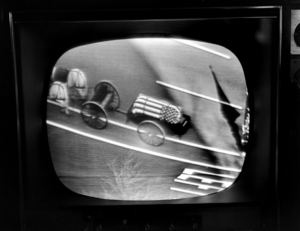
Fast forward a couple days, and I am sitting in front of our black-and-white television in the sitting room downstairs. The funeral procession is being shown, and the coffin is draped by the American flag, being pulled by an official military wagon with big wooden wheels. Everyone is walking very slowly, and the camera zooms in on his wife Jacqueline with her black veil covering her face and the children holding hands.
In my mind, I was also part of history in the making in my own small way. The memory lives on in my head. Just think how history could have been so different.
I was very surprised to receive the following message recently:
I found a 2001 mention of the USS Meade, DD 602, on your blog. I am looking for an appropriate home for pictures showing life on the Meade during WW II.
My dad, Harry J. Greenspan, was a Lt JG who served as assistant Communications officer and then Communications Officer on the Meade from 1943-1945. He was detached after the war ended for TDY in New York City, where he helped put the ship's album together. Dad died in October 2012. Going through his belongings, I found 8"x10" glossy prints and small contact prints for the pictures in the album, as well as some pictures that didn't make it into the album. Is there an appropriate home for these?
Sincerely,
MG
This just goes to show you how mazing it is that such modern technology called the Internet connects us in surprising and unusual ways.
Inspired very much by this message, I've become sentimental again and will re-enable the web page tribute to this fine fighting ship that my father was on during WWII.
I'm sure glad I didn't live back in the days of the Spanish Armada. In the book "The Confident Hope of a Miracle" by Neil Hanson, the events leading up to and surrounding this famous historical event are described in every kind of detail. This is really interesting reading and every chapter leaves me amazed at what went on back in those days.
In those days you had a number of ruthless heroes. For example, Sir Francis Drake was a notorious pirate who attacked many ships. His specialty was harassing Spanish shipping and ports and capturing gold treasures for Queen Elizabeth.
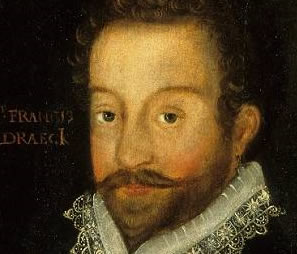
Sir Francis Drake, El Draque "the Dragon"
Protocol back then meant that when your ship was attacked, you had two choices. Either you surrendered immediately and you and your men were taken prisoner, or you fought back. If you fought back and lost, then every person captured would be killed, sometimes in excruciatingly gruesome ways. This was accepted practice, so you can imagine how worried you might be when the battle started.
One common practice was to flay the prisoners alive, and then hang the bodies upside down from the masts. It was better to be killed outright, rather than being merely wounded and later skinned alive. This was a warning to other ships, making them reconsider entering a fight with this person the Spanish referred to as El Draque "the Dragon" who was sent by the devil.
Another interesting fact about the defeat of the Spanish Armada was that the tactics of sea battle were changed drastically. Since ancient days, fighting at sea was done just like on land. The only difference was that the two ships would approach each loaded with soldiers, the goal being to get close enough and grapple together, allowing the attackers to jump on the defending ship and initiate battle there.
What led to the defeat of the Spanish was that the English had faster ships which could maneuver to a safe distance from the enemy and open fire with cannons and other artillery, sinking or immobilizing the enemy.
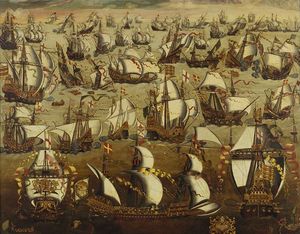
Borrowed from Wikipedia, Spanish Armada
This was very frustrating to the Spanish and caught them completely off guard. It was completely against all accepted rules of war. The poor Spanish would be cursing and yelling at this unfair way of waging war, as the poor souls sank to the bottom of the English Channel.
History can be a very fascinating subject for me, and on occasion I go to the local bookstore, look around a little in the history section, and purchase a book or two that seem interesting to me.
With that in mind, I had high hopes when I started reading the hardcover book called Moral Combat which covers the Second World War from the early beginnings to the very end, a book which attempts to analyze the events of that terrible time in view of the social and moral implications of various political decisions.
The book has received many positive reviews, so I was very eager when I started reading it.
However, struggling to understand difficult and esoteric language is not my idea of relaxed reading, so after barely making it through to page seventy, I'm feeling very frustrated. Here's a typical example of the author's pompous and exaggerated style which tires my mind rather than excites it:
"But the ineffable uniqueness of suffering can also mutate into its sacralisation, a finite quantum that is forbidden to subtract from or to diminish through revised totals or lateral comparisons ..."
The hardest part is not just getting through to the end of such convoluted sentences, but each time trying to swallow the tangled mass and understanding what the heck he's talking about.
Why an author would write this way to an eager reading public is beyond me, I mean what the heck is he trying to prove? I just wanted to learn more and not be reminded that I'm such a lowly un-scholarly soul who can't understand things.
For the time being I've returned it atop my pile of unread books and will decide another day whether to give it another try when I'm a bit older, wiser and more patient.
Seventy years ago to this day, the Rotterdam blitz took place. That must have been a nightmare, an unbelievable and surrealistic experience only a couple days after news of the German invasion across the eastern border of Holland.
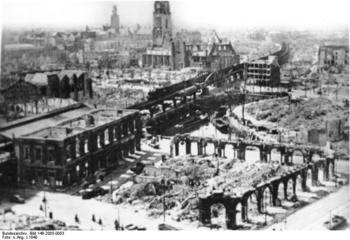
Rotterdam after bombardment.
After invading Holland, the Germans shot up everything in sight, quickly making their way to the city of Rotterdam, where at the city's borders they were opposed by fierce resistance of the far inferior Dutch military forces.
Fearing the destruction of their historical city which they loved dearly, a peace treaty was signed. Ironically, due to chaotic miscommunication and the fact that the bomber squadron had already been launched and could not easily be recalled, the city center was completely flattened, razed to the ground. Around 800 innocent city occupants were decimated in the flash fires that ensued.
They say that the city center was as impressive as Amsterdam with all of its canals and gabled houses, but very little of it is left. What was once a romantic collection of houses and alleys built during the 1600's is no more.
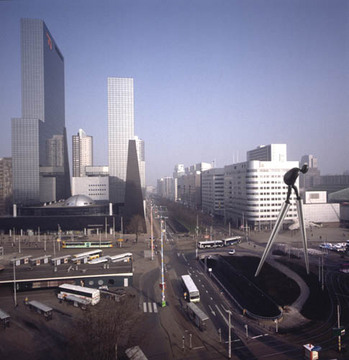
Rotterdam today.
Rotterdam is about a twenty minute drive from my house. What I see now whenever I visit Rotterdam is a bunch of straight, wide roads, high rises and modern offices made of steel, wire and glass. An unusual site in Europe, where a modern-looking city seems like it has risen out of nowhere.
Risen from the ashes of war, hard to believe.
Nature is pretty skilled at paralyzing modern civilization in more ways than one. She has changed the course of human history using her powers to unleash snowstorms, floods, earthquakes, tsunamis, etc. Many wars have been won or lost because nature felt the need to meddle in our affairs right then and there.
For the second day in a row, I will have to work from home because of the tons and tons of snow which have been falling everywhere. The trains have been rendered useless and trying to drive a car will get you no further than the end of the block. Even bicycling, the traditional Dutch means of transportation, is not highly recommended. Go out there and slip and slide and break your arm, wrist or ankle, that's alright.
Not that she expects us to worship her like some all powerful goddess, that is the least of her worries right now. Rather, she wants us just to stop and think, look in awe at her beautiful presence, realize that just a simple whim of hers can blow us over with a snap of her fingers.
From my work room in the attic I spy pure whiteness as far as the eye can see and it is a good feeling.
A couple weeks ago, a blog reader by the name of Harry Gish sent me the following message:
A rather odd one loaded both with heroism (in the Revolutionary War where the three oldest sons of Matthias and their sons fought with Washington, the middle one being killed in Battle, despite being Dunkard ministers who were supposed to be pacifists), strange Civil war action where my great grandfather had to alter his name and age AFTERWARDS, not before (Matthias was my 6th great grandfather) to the "fee tail male" (oldest surviving son of the oldest surviving son ...) line in Paducah, KY who had a broad spectrum of WWII service, including my father who was the ACTUAL Boogie Woogie Bugle Boy ... all those accounts of "I was in the company when it happened" need to be aware the song was written for an Abbott & Costello movie in 1938-39 whereas Harry Lucien Gish was the star trumpet player in the Will Bradley All-Star Band. The songwriters of the movie wrote most of the Bradley band's boogie woogie hits ...
BTW, Christian Gish I and Christian Gish II served in captain Peebles' Company in the revolutionary war. Next brother was John who was killed in battle in 1783. Next brother Abraham was the great-grandfather of the actresses Lillian and Dorothy. By the war of 1812 both they had settled in the Roanoke, VA area but Christian II had moved on to Muhlenberg County in western Kentucky a decade prior though undoubtedly there were plenty left to have been in the war. I am not aware of any, however.
As the One Great Family Network Christian Gish I family administrator I usually only follow/investigate that line (which numbers possibly as large as 10,000). In addition to James Christopher's unusual participation in the civil war he had a first cousin named Benjamin Franklin Gish who served in the Louisiana Infantry.
Strange how human nature causes us all to attach symbolic meaning to round numbers of the largish kind.
Take for instance the number thousand and consider it's significance in history, as explained in detail in the current book I'm reading: "Millennium" by Tom Holland.
In the Bible it is written that the millennium will bring about much war and destruction to the planet earth. Many poor souls during the Middle Ages were pretty pre-occupied with the coming of the millennium, and much history of that period was greatly influenced by such predictions.
The amazing thing is that even to this day people remain gullible about the number thousand, thinking that the end of the world will still come when it hasn't. I bet that it will never come.
Wasn't the failure of the first millennium proof enough not to believe in such a ridiculous prediction?
The population here is still suffering from the remnants of a war that began more than seventy years ago.
Just yesterday they uncovered yet another middle-sized bomb just next to the railway tracks not far from the very spot that I get on the train every morning.
Unleashed from high above, the black object hurdles to the ground and embeds itself deep into the mud. Many explode upon impact killing those poor souls nearby, but not this one.
How many more hidden bombs are there still out there awaiting discovery from a generation which has nearly forgotten the atrocities of a time long lost?
"...I am talking to you by telephone from the Oval
Room at the White House, and this certainly has to be the most historic
telephone call ever made from the White House. I just can't tell you how proud we all are of what you have done. For
every American this has to be the proudest day of our lives, and for
people all over the world I am sure that they, too, join with Americans
in recognizing what an immense feat this is. Because of what you have done the heavens have become a part of man's
world, and as you talk to us from the Sea of Tranquility, it inspires
us to redouble our efforts to bring peace and tranquility to earth..."
I was twelve years old and watched it all on our old-fashioned black and white television, feeling very proud and patriotic.
I was twelve years old and watched it all on our old-fashioned black and white television, feeling very proud and patriotic.
"The Sea of Thunder" by Evan Thomas is a very engaging book from beginning to end. It explores not
only all of the historical facts but also does a good job in presenting
the personalities of four commanders and how their decisions made a
permanent mark on history. By far the most interesting character was
that of Admiral William Halsey in which circumstances led him right up
to the largest sea battle in history. However, due to a complex chain
of events combined with the tricky strategy of the enemy he made the
decision to go northwards away from immediate confrontation. I had to
feel real sorry for him because like Ismael's lifelong search for Moby
Dick, Halsey was fixated with meeting the Japanese in battle, causing
him at the wrong moment to sail north where he thought the enemy was
coming when if he'd only waited a little longer he would have met and
destroyed his nemesis in one sweeping amazing sea battle which was
never going to happen.
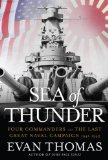
Review International Herald Tribune
Review International Herald Tribune
When the beautiful stallion was first brought out for royal inspection, he bucked wildly and galloped in angry motions, refusing to heed any commands whatsoever.
Indeed it was a nearly hopeless situation, like what happens so often in real life, but even the finest of the soldiers, cavalry and experienced horsemen were unable to appease this wild beast.
The mighty King Philip of Macedonia ordered the horse to be taken away and dealt with properly. Take him away now!
Upon seeing this, the young prince stood up, shouted stop! He had become enthralled by the display of the beast's energy and wildness, seeing what had been broiling inside him all this time. That's when he dashed out towards the fated horse, hands raised before him, promising to master even the impossible.
He noticed that it was merely skittishness caused by seeing one's own shadow in the bright sun, so the boy patted and gently stroked the animal's mane, until the horse was soothed and became still.
The name of the horse was Bucephalas and it was Alexander's for the keeping. He was to be his companion through war and prosperity for the next twenty years of conquest.
Famous worldly conquest, and even more.
No one thinks that it could have been otherwise, and this is the essence that makes history what it is.
To master the impossible is much of what it is all about.
Exactly eighty-nine years ago today, our hero Kiffin sacrificed his life for freedom when he was shot down over France during the Great War.
Thanks alot for doing this, in more ways than one.
"And so it was that his mother, in Asheville, North Carolina, asked herself why it was that she, a Carolinian by birth and sympathy, should sacrifice her son in France, and her questions were augmented by similar ones from relatives and friends all over the country. Kiffin, though gloriously dead, might have been saved, it seemed. She had tried to save him from himself by persistent entreaties to the Department of State in Washington to get her boy out of the French army, and by similarly persistent demands to the French Government to release her son. But before Kiffin fell she had come to see what he was fighting for, and it was not long after he fell before she was a sister in suffering to thousands of other American mothers who likewise had come to see why it was that their sons had to die in France..."
When he came home from school that day, he was surprised that his home just wasn't there any more. Sure he had heard the sirens in the distance and he was aware that the Germans were attacking the city of Rotterdam. However, he had never expected to come home and discover that he had nothing any more than the clothes he was wearing.
Maarten really wanted to go visit the Oorlogs Verzets Museum Rotterdam so I took him there this Sunday afternoon. He had been waiting all week long, and every evening when I brought him to bed he would tell me that there were only so many days before we would go.
Once we arrived there, we received our own personal tour from a guide who was a survivor of the awful bombardments during the outbreak of World War II. He was seventy-seven years old and had alot of personal details to share with us and it was heart-breaking to hear of all the atrocities during that period of history. He was Lennart's age when they deported him to Germany for forced labor.
With a scratchy voice and slightly trembling hands he relived the many experiences anew so that Maarten would learn and be aware and prevent this from ever happening again.
Maybe some day humanity will have learned its lesson, but until then we will all have to be patient and do our best to survive from day to day.
An interesting article appeared on the Citizen Tribune Web site today and I am mentioned a couple of times believe it or not.
It goes something like this:
Continue reading History in Newport.
Forty seven is a nice round number, especially since the two digits add up just right to my favorite number. Four plus seven equals eleven.
Exactly eighty-eight years ago to this day, Kiffin Yates Rockwell was shot down and killed by a German flyer during WWI over Roden, France.
Thanks Kiffin for sacrificing your life for the love of freedom and my right to carry on your name proudly into the twenty-first century.
In my heart at least you will live on and on.
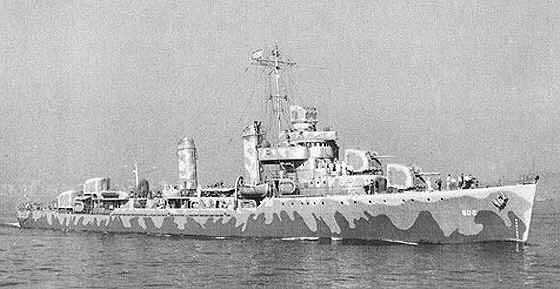 USS Meade DD-602 (enlarge). |


Recent Comments
- Charles
- jpmcfarlane
- Kiffin
- jpmcfarlane
- KathleenC