Category: Books

 | Books | 0 Comments

One of my favorite scenes in "The Angel's Game" by Carlos Ruiz Zafón is when David finally finds Cristina wandering aimlessly on the frozen lake:

...

I followed the tracks as far as the park that bordered the lake. A full moon burned over the large sheet of ice. That is when I saw her. She was limping over the frozen lake, a line of bloodstained footprints behind her, the nightdress covering her body trembling in the breeze. By the time I reached the shore, Cristina had walked about thirty metres towards the centre of the lake. I shouted her name and she stopped. Slowly she turned and I saw her smile as a cobweb of cracks began to weave itself beneath her feet. I jumped onto the ice, feeling the frozen surface buckle, and ran towards her. Cristina stood still looking at me. The cracks under her feet were expanding into a mesh of black veins. The ice was giving away and I fell flat on my face.

"I love you," I heard her say.

I crawled towards her, but the web of cracks was growing and now encircled her. Barely a few metres separated us when I heard the ice finally break. Black jaws snapped open and swallowed her up in a pool of tar. As soon as she disappeared under the surface, the plates of ice began to join up, sealing the opening through which Cristina had plunged.

...

There's more and it gets better and better, but I don't want to spoil it all for those who want to read this fantastic novel.

This is just one of many gripping parts of the book which takes place in the old, shadowy sections of Barcelona and surroundings. The story is an excellent read, although you will probably want to reread certain sections in order to get the most out of the darker and more mysterious chapters, trying to figure what's real and what's coming from the author's fantastical mind.

 | Books | 0 Comments | 0 TrackBacks

I'm now reading the book "Sea of Poppies" by Amitav Ghosh and really like it. I like it so much that after having read the first one hundred pages, I found it so entertaining that I went back and read it all over again just in case I might have missed something (I did and maybe I should reread it again).

The backdrop of the book takes place during The Opium Wars of the eighteen hundreds, and the way the author writes pulls you into the story with such force that it's like you are walking right next to the characters and seeing stuff they see. Take the following excerpt for instance and upon reading it close your eyes and imagine you are there:

"The town was small, just a few blocks of houses that faded away into a jumble of shacks, shanties and other hut-houses; beyond, the path wound through dense patches of forest and towering, tangled thickets of sugar cane. The surrounding hills and crags were of strange, twisted shapes; they sat upon the plains like a bestiary of gargantuan animals that had been frozen in the act of trying to escape from the the grip of the earth."

Trying to follow the language of the so-called lascars (crew members onboard the ship) is sometimes frustrating, but if you need a helping hand with the strange slang you might want to print out the Ibis Chrestomathy and keep it on hand while reading the book.

On the one hand you have God playing with opium and using it as an instrument of fate, and on the other hand you have a list of characters entangled in a web of complexities and deception.

 | Books | 0 Comments
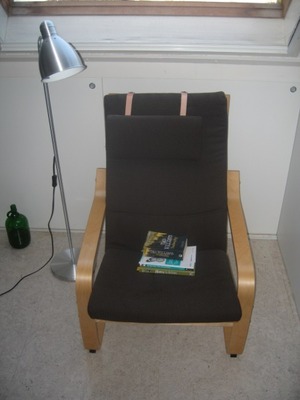
Lately I've been able to spend much time in the evenings reading one book after the other. I can sit down in my simple reading chair feeling relaxed as my mind dives into and gets totally lost in one world or another. The large window behind provides ideal light until it get too dark in the evening at which time I can flick on the standing lamp to the right.

Reading_chair.jpg
This is my reading chair.
 | Books | 0 Comments
Here is my personal review of "Extremely Loud & Incredibly Close" by Jonathan Safran Foer, which I just finished today.

This is not the easiest book to read. Some parts I really had to struggle through, but I must admit that the author uses some clever unorthodox ways of getting his points across. I only started understanding the plot fully when I was about half way through, and I believe that I would have enjoyed the first half better had I known in advance what the plot was about. The dual nature is of two disasters: one being the Dresden bombing during WWII and the other being the aftermath of losing a father during the 9/11 tragedy. There are two generations: a young boy named Oskar trying to make sense of things and finding a mysterious key by chance in a blue vase that he lets fall, and the grandparents immigrating after the war, the mute grandfather who for some reason left and the grandmother was has never forgiven him and becomes infatuated with the young boy. Better stop now so I do not give away too much. Read it for yourself and enjoy.
 | Books | 0 Comments
The following is an especially powerful excerpt from the book "Love in the Time of Cholera" by Gabriel Garcia Marquez which in beautiful prose describes the essence of the book and the theme around which the whole plot revolves.

"By the time she had emptied the teapot and he the coffeepot, they had both attempted and then broken off several topics of conversation, not so much because they were really interested in them but in order to avoid others that neither dared to broach. They were both intimidated, they could not understand what they were doing so far from their youth on a terrace with checkerboard tiles in a house that belonged to no one and that was still redolent of cemetery flowers. It was the first time in half a century that they had been so close and had enough time to look at each other with some serenity, and they had seen each other for what they were: two old people, ambushed by death, who had nothing in common except the memory of an ephemeral past that was no longer theirs but belonged to two young people who had vanished and who could have been their grandchildren. She thought that he would at last be convinced of the unreality of his dream, and that this would redeem his insolence."

Read it carefully once or twice until it rings true in your mind, and hopefully like me you will also be struck by the deep yet disturbing meaning.
 | Books | 0 Comments
Whenever you are feeling down, the best way to make yourself feel better is to order a bunch of books from Amazon.
 | Books | 0 Comments | 0 TrackBacks
I cannot believe I somehow managed to struggle through all 762 pages of the book Shadowmarch by Tad Williams.

This fantasy saga is not terribly exciting but there was something about it that kept me reading on and on to the end for some reason.

To be honest, a book must be really bad if I do not finish it after having read the first couple of hundred pages.

It's the first part of a trilogy, and before I'd started the first book I'd already purchased the second book Shadowplay (761 PAGES) in anticipation, having read so many positive reviews.

"A sublime piece of storytelling!"

Maybe it has to do with the fact that I'm not what you'd call an overly avid fan of fantasy. Hopefully the second and third books are better.
 | Books | 0 Comments | 0 TrackBacks
What especially appealed to me about the following book excerpt was the part about the saving rope being lowered from above, as if just by reaching up and holding onto it one is whisked away from the mundaness of the everyday world in which we sluggishly push along.

"But for me it was enough if, in my own bed, my sleep was so heavy as completely to relax my consciousness; for then I lost all sense of the place in which I had gone to sleep, and when I awoke at midnight, not knowing where I was, I could not be sure at first who I was; I had only the most rudimentary sense of existence, such as may lurk and flicker in the depths of an animal's consciousness; I was more destitute of human qualities than the cave-dweller; but then the memory, not yet of the place in which I was, but of various other places where I had lived, and might now very possibly be, would come like a rope let down from heaven to draw me up out of the abyss of not-being, from which I could never have escaped by myself: in a flash I would traverse and surmount centuries of civilisation, and out of a half-visualised succession of oil-lamps, followed by shirts with turned-down collars, would put together by degrees the component parts of my ego."

Remembrance of Things Past: Swann's Way - Marcel Proust
 | Books | 0 Comments | 0 TrackBacks
Rumor has it that I've decided to become some kind of Linux expert. So who am I trying to kid?!

At least I was happy when I came home today and discovered the big box from Amazon lying on the cabinet in the hallway entrance.

New challenges on the horizon are:

  • Understanding the Linux Kernel by Bovet & Cesati
  • Linux Device Drivers by Corbet, Rubini and Kroah-Hartman
By the way, there was also a more "normal" book as part of the shipment, namely:

  • A Spot of Bother by Mark Haddon
Two days ago I finished his first book called The Curious Incident of the Dog in the Night-time which I really liked.

On my way home yesterday, I stopped at the bookstore at the train station and purchased the following two paperbacks:

  • Love in the time of Cholera by Gabriel Garcia Marquez
  • Shadowplay by Tad Williams
When I realized I'd inadvertently bought book two I quickly went to Bol.com and ordered book one:

  • Shadowmarch by Tad Williams
Am I getting overly addicted to buying books or what? No matter, I've got lots of time to read it all in the train, about two hours per day which is ten hours per week (or about one good novel a week).
 | Books | 0 Comments | 0 TrackBacks
I am sitting in the train on my way to work reading the book "The Curious Incident" by Mark Haddon.

When I finish the next chapter I look up and gaze out of the window reviewing in my mind all the stuff I just read.

Over to my left sitting next to the window, I see a younger well-dressed man who is also reading a book. Realizing unconsciously that some other stranger is gazing in his direction, he stops reading a looks back at me.

That is when I avert my glance, but just ever so slightly so that out of curiosity I can have a peek at the book he is reading. I'm always really curious what kind of books, magazines or whatever the other fellow passengers are reading.

Then to my surprise I discover that he is reading the very same book I am. It's a slightly larger edition than the copy I'm holding in my hand, but it is nonetheless the identical book. It also looks like he has read the same amount that I have, about three eighths of the book.

I wonder what the odds are that I am sitting across from someone who is reading the very same book that I am. The odds of winning the lottery are probably much better, so this is a unique moment that I should appreciate as long as possible.
 | Books | 1 Comment | 0 TrackBacks
Upon the first reading of the following paragraph, I was struck by its profound meaning and disturbed by its painful truthfulness at the same time. It's stuck in my head ever since, and I've reread it on a number of occasions in order to be able to soak in the totality of its forcefulness.

"At the imminent prospect of battle one experiences a wild excitement that precludes rationality. But in the boredom of waiting for it, one's mood changes. The excitement transforms itself into a kind of thoughtfulness that is solitary, but which requires the reassuring presence of others; people offer each other cigarettes in low voices, and when they pat each other's backs, their touch feels the need to linger. Some write notes or poems that will be found upon them after the event of their death, detailing regrets and previously unacknowledged longings. Others pass the time dismantling, cleaning, and reassembling weapons that are already in immaculate condition. They pass handfuls of ammunition from one pocket to the other, weighing up the best way to distribute it for ease of access. Others walk about with their hands in their pockets, smiling wanly, and with genuine affection, even at those who have always annoyed them intensely. Everyone looks at the world with heightened acuity, as though perceiving for the first time the globular abdomen of an ant, or the porous texture of snow."

- The Troublesome Offspring of Cardinal Guzman by Louis de Bernieres.

Other books by him that I've read:
  • Captain Corelli's Mandolin
  • Birds Without Wings
  • Red Dog
 | Books | 0 Comments

Well I finally finished the long and daunting Dan Simmons tetrology Hyperion Cantos consisting of the following four books: Hyperion (482 pages), The Fall of Hyperion (517 pages), Endymion (563 pages) and The Rise of Endymion (709 pages).

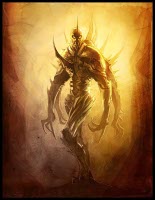
After having made my way through these 2271 pages, I would not dare expose whether or not The Shrike made it nor what important role he ended up playing together with Aenea, Raul Endymion and the blue android A. Bettik and the survival of the universe, not to mention Old Earth.

The_shrike.jpg

Looks mean but has a good soul.

 | Books | 0 Comments

"We may, indeed, say that the hour of death is uncertain, but when we say this we think of that hour as situated in a vague and remote expanse of time; it does not occur to us that it can have any connection with the day that has already dawned and can mean that death may occur this very afternoon, so far from uncertain, this afternoon whose timetable, hour by hour, has been settled in advance. One insists on one's daily outing, so that in a month's time one will have had the necessary ration of fresh air; one has hesitated over which coat to take, which cabman to call; one is in the cab, the whole day lies before one, short because one must be back home early, as a friend is coming to see one; one hopes it will be as fine again tomorrow; and one has no suspicion that death, which has been advancing within one on another plane, has chosen precisely this particular day to make its appearance in a few minutes' time . . ." - Marcel Proust, The Guermantes Way.

I took the liberty to copy this quote used at the beginning of the latest novel by William Boyd called Restless, which I am currently reading, because I found the quote really insightful and appropriate.

 | Books | 0 Comments

In need of a spiritual recharge so that I can get myself in a rejuvenated mood of inspiration, I went to the American Book Center and bought myself a copy of The Power of Your Subconscious Mind by Dr. Joseph Murphy.

By thinking positive thoughts I can achieve amazing miracles, at least that is what the book claims.

 | Books | 0 Comments

In his new book, Richard Dawkins continues the great God debate in spectacular fashion, although he has the tendency to hit hard at those poor souls who unthinkingly base their beliefs purely on blind faith.

Although from the scientific view of things he makes sense with his convincing arguments, he has the tendency to really go out of his way to put down believers endlessly. I'm not so sure the effort is really worth it.

If there truly is a God, then it really doesn't matter anyway whether or not this book is true. I read it purely for its entertainment value (and hope that in the end God will not strike me down because I am reading for fun).

 | Books | 0 Comments

After having reread the first book of His Dark Materials by Philip Pullman I gained much momentum and finished the whole trilogy within a week. Truly a fantastic story. Too bad that Lyra and Will had in the end to be separated from each other for the good of the future of humanity but I guess that was bound to happen considering events between worlds and the way they were supposed to overlap.The subtle knife gets broken (purposely) and there is no turning back, but the dust ceases to drift for no reason at all and all openings to other worlds are sealed off for the sake of keeping history under control.

 | Books | 0 Comments

"Beneath this colossal fortress, fires glared and furnaces smoked in the darkness of early dawn, and from many miles away Ruta Skadi heard the clang of hammers and the pounding of great mills. And from every direction, she could see more flights of angels winging towards it, and not only angels, but machines too: steel-winged craft gliding like albatrosses, glass cabins under flickering dragonfly-wings, droning zeppelins like huge bumble bees — all making for the fortress that Lord Asriel was building on the mountains at the edge of the world."

from The Subtle Knife (chapter 6: Lighted Fliers) by Philip Pullman

 | Books | 0 Comments | 0 TrackBacks

A story is a letter the author writes to himself, to tell himself things that he would be unable to discover otherwise.

An excellent read ...

 | Books | 0 Comments | 0 TrackBacks

This masterpiece collection should prove to be an excellent read.

The other day while sitting in the car and listening to the BBC Radio, I just happened to hear an interesting interview with some author named Philip Pullman.

I became so interested in his philosophical ideas and beliefs that I had to order the book immediately. Can you believe that before that I had never heard of this person?

The massive volume arrived yesterday from good old Amazon.co.uk, and I have already lost myself in its many many pages.

Still young inside.

 | Books | 0 Comments | 0 TrackBacks

As if nearly all of a random infinity of knowledge can be pressed inside of a single mind, but why give up?

There is just too many interesting things to keep on learning and learning.


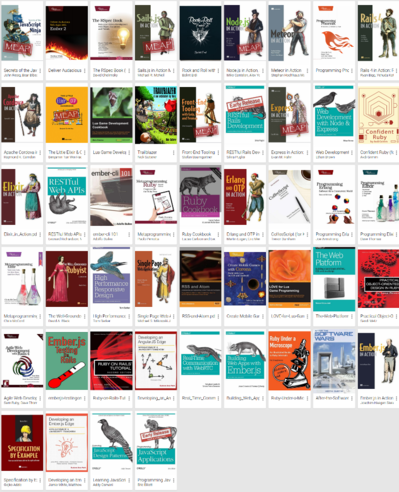
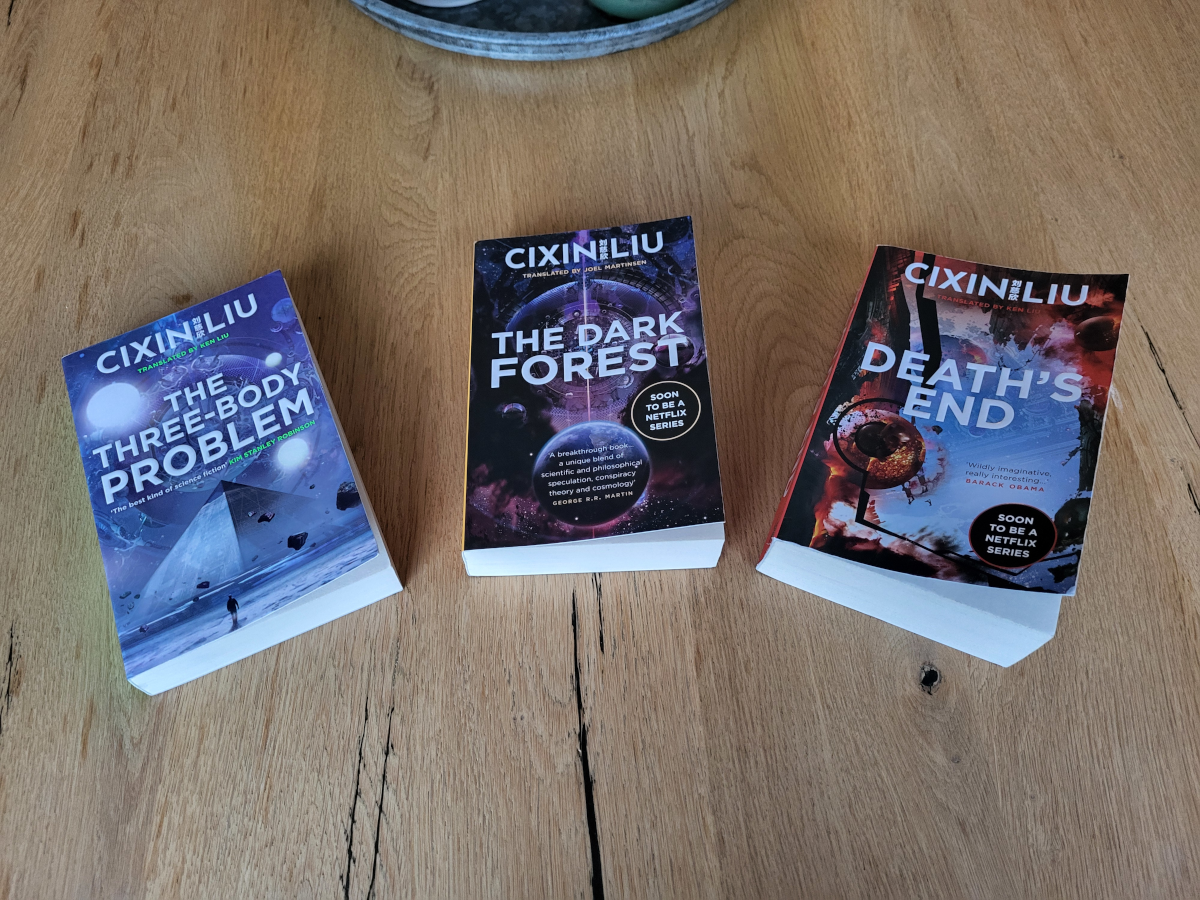
Just a 'few' of my computer books.

 | Books | 0 Comments | 0 TrackBacks

Sometimes the pursuit of knowledge gets out of hand and consumes too much of my life. Take for example the fact that at any given time I cannot just stick with one book, but I have to read a bunch of variegated subject matters simultaneously. Impatiently reading this and that and all kinds of other stuff.

  • Alexander the Great - Robin lane Fox, page 172 of 498.
  • High Peformance MySQL - Zawodny & Balling, page 217 of 265.
  • Lunar Park - Bret Easton Ellis, page 47 or 307.
  • Ambient Findability - Peter Morville, page 76 of 188.
  • To The Last Man - Jeff Shaara, page 146 of 636.
  • Switching to VoIP - Ted Wallingford, page 162 of 451..

Information overload. What's it all for? What am I trying to prove?

 | Books | 0 Comments | 0 TrackBacks

I am an avid fan of the O'Reilly series of computer books, and during the last few years I have been able to increase my knowledge immensely thanks to this informative and entertaining literature.

In case you are interested, here is the alphabetical complete list of 25 books I currently own, more than half of which I have read at least two times over:

  • Advanced Perl Programming, 2nd Edition
  • Ambient Findability
  • Apache: The Definitive Guide, 3rd Edition
  • Asterisk: The Future of Telephony
  • BSD Hacks
  • CGI Programming with Perl, 2nd Edition
  • Essential CVS
  • Google Hacks
  • Hackers & Painters
  • Java Web Services
  • JavaScript and DHTML Cookbook
  • JavaScript: The Definitive Guide, 4th Edition
  • Learning Perl Objects, References, and Modules
  • Learning UML
  • Perl & XML
  • Perl 6 Essentials
  • Perl Best Practices
  • Perl Cookbook
  • Perl Template Toolkit
  • Programming Perl, 3rd Edition
  • SQL Pocket Guide
  • Switching to VolP
  • The Complete FreeBSD, 4th Edition
  • Web Design in a Nutshell
  • XML in a Nutshell, 2nd Edition

Visit the O'Reilly Network on the Web at www.oreillynet.com

 | Books | 0 Comments | 0 TrackBacks

"That night the Kelly Gang made camp by light of rain & lightning strikes and while the boys lay quiet as dogs wrapped up in their coats I sat with my backside in a puddle my oilskin above my candle & my paper.

I begun again they could not prevent it. I were the terror of the government being brung to life in the cauldron of the night."

- True history of the Kelly Gang, Peter Carey.

 | Books | 0 Comments

"I awoke once during the night. I pushed the canopy aside and looked out. The moon was a sharply defined crescent and the sky was perfectly clear. The stars shone with such fierce, contained brilliance that it seemed absurd to call the night dark. The sea lay quietly, bathed in a shy, light-footed light, a dancing play of black and silver that extended without limits all about me. The volume of things was confounding—the volume of air above me, the volume of water around and beneath me. I was half-moved, half-terrified."

- Yann Martel, Life of Pi (chapter 60)

(There are certain book passages that when you read them for a second, third or even more times they really move you - this is one such passage)

 | Books | 0 Comments

If we, citizens, do not support our artists, then we sacrifice our imagination on the altar of crude reality and we end up believing in nothing and having worthless dreams.

- Yann Martel, Life of Pi (author's note)

 | Books | 0 Comments

So what the heck am I doing reading good old entertaining fiction? When I should be concentrating all of my efforts now on setting up a half-decent business, e.g. if I happen to have any time left over at the end of the day to read books then it should have something to do with book-keeping, management, marketing or whatever. Heck, I am not some humanoid machine purring endlessly over there in the corner now am I? Tough luck, I need to relax once in a while. I cannot help it if I am addicted to good books now, can I?

For some reason I have read Hornby's books backwards, that is in reverse chronological order to publication dates. The third book High Fidelity I ended up reading by him happens to be his very first book, the one which got him famous in the first place. Not as good as the other two: About a Boy (made into a film with Hugh Grant) and How to be Good. But if you can get beyond the British slang and the pop music trivia it can be quite entertaining. Even some one as boring as I had a good laugh during some of the more hilarious scenes. I recommend it highly for the beach where you just need to distract your mind, not think too much, and enjoy the ocean breeze.

If you are wondering what the book is really about, here's a generic objective kind of review I found on the Amazon.com web site:

"For Rob Fleming, thirty-five years old, a pop addict and owner of a failing record shop, these are the sort of questions that need an answer, and soon. His girlfriend has just left him. Can he really go on living in a poky flat surrounded by vinyl and CDs or should he get a real home, a real family and a real job? Perhaps most difficult of all, will he ever be able to stop thinking about life in terms of the All Time Top Five bands, books, films, songs - even now that he's been dumped again, the top five break-ups?"

 | Books | 0 Comments

I just finished the book "A Landing on the Sun" by Michael Frayn, and like all of the other books I read by him (Headlong and Spies), I really loved it. This is the plot, in my own words.

"When a conservative civil servant mysteriously falls to his death, rumors abound that this is somehow connected to a top secret defense project. The author, a civil servant himself, is called in to investigate the events leading up to this tragic event. What he slowly and professionally unveils is a complicated and bizarre series of entwined occurrences and coincidences. As it turns out, the esoteric topic 'The quality of life' and the research project led by a firm-handed but lovely Russian woman, combined with the blindness of love, is what makes this story no less than remarkable. What at first appears as a mundane, boring and predictable theme, unfolds with elegance and skill. An excellent plot mixed in with just enough philosophy and psychology to keep the reader going until the very end."

This is a fantastic book which I can recommend highly for those readers out there who do not shy away from slight complexity and an occasional vagueness in pursuit of the more intellectual awards these kinds of books have to offer.

 | Books | 0 Comments

"When considering a life change, we let our fears govern our decisions. Rather than challenging the validity of those fears, we accept the boundaries set by those fears, and end up confining our search to a narrow range of possibilities, like the guy looking for his car keys under the streetlight because he's afraid of the dark." -- Po Bronson.

The sagging economy is getting worse and worse, forcing many people to turn inward and re-evaluate their careers. One begins to wonder what it is all worth and what is the best route to take after one has supposedly accomplished everything (or nothing).

The book What should I do with my life? is an attempt to chronicle the quest to the answer of the most important question there is. If you have Real Audio installed, you can listen to the Morning Edition Audio from the NPR homepage.

The most common misconceptions turn out to be that:

  1. money is the shortest route to freedom.
  2. we can think (or analyze) our way to an answer of where we belong.
  3. we are autonomous from the environment that surrounds us.
  4. our biggest obstacles are external, rather than internal.

You might also want to join the Yahoo Life Goals mailing list. I did. Now it is my turn to do something with my life.

 | Books | 4 Comments

So I finally finished the (thin) book called "Freedom From The Unknown" by my spiritual hero Krishnamurti, and I must admit that I found it a fairly entertaining and useful read. The whole book is only a little over a hundred pages long, but by reading each chapter slowly, and then rereading each chapter over and over, and then going back to reread a previous section again and again, this short piece became a long piece to peruse and to cherish at the same time. Afterall time is nothing isn't it? I love to read books, and this one provided me with the necessary spiritual escape from the doldrums of my present day-to-day life. At times the book was a little too repetitive and on the predictable side, how one must look within and ignore the external reality when searching for one's true self. Reject authority and theologies that are unnecessary burdens which need to be thrown off. However, the essence of the book was very difficult for me to appreciate, as it is contrary to common thought. Alot of not this and not that, rather than focusing on the true positive nature of what is. Makes me wonder why I am even reading the book in the first place. Afterall, isn't the act of reading based upon understanding facts in the form of words and sentences?

"It is very important to understand from the very beginning that I am not formulating any philosophy or any theological structure of ideas or theological concepts. It seems to me that all ideologies are utterly idiotic. What is important is not a philosophy of life but to observe what is actually taking place in our daily life, inwardly and outwardly... Having realized that we can depend on no outside authority in bringing about a total revolution within the structure of our own psyche, there is the immensely greater difficulty of rejecting our own inward authority, the authority of our own particular little experiences and accumulated opinions, knowledge, ideas and ideals."

In effect, the author states that we should not listen to spiritual leaders nor should we read their literature as this will inevitably blind one from the true unfettered inner pursuit of the self. Isn't this a bit of a dilemma (ironic) when you think about it openly? I guess Krishnamurti purposely uses this ironic twist of ideas in order to get his point across, but it still does not make sense. He says we should not follow leaders, and yet he is a leader with followers. He also states that you will not gain enlightenment through the written and/or spoken words of others, and yet here is Krishnamurti collecting a bunch of words on paper which he has consciously been kind enough to have done in order to help others like myself. If I believe what he writes, then I can not believe what he writes. And if I do not believe what he writes, then I had better not read the book in the first place as it would be a big waste of my time. Get it or not? The true spirit is what we are here for in the first place.

 | Books | 0 Comments

Just finished the latest novel by Michael Frayn called "Spies" and it was pretty darn good. I find the way that Mr. Frayn writes very refreshing, with an interesting mix of artistic prose balanced with a solid storyline which always keeps the reader on his toes. This book is about an older man who finally returns to the neighborhood of his youth, in England where he grew up during World War II, in order to deal with some obscure thoughts and feelings about a certain event he has been carrying with him his whole life. Seems he and his friend Keith have gotten a little carried away in playing the adventure where Keith's mother is a supposed German spy. Playful enough and well written through the eyes of an adult as seen through the eyes of a child, at least how the man remembers it within the limited perception of childhood memories. The way the story matures and the plot which is woven into the thread of the novel will keep you occupied. The unexpected ending makes the whole read worthwhile, and it will certainly keep you thinking about human ideals, the pains of war and the often forgotten personal stories of the true sufferers of that awful episode in European history. Yes, I recommend this book very very highly. Here is a quote to give you a better idea.

"I feel more strongly than ever the honour of my association with Keith. His family have taken on the heroic proportions of characters in a legend - noble father and traitorous mother playing the never-ending conflict between good and evil, between light and dark. Now Keith himself is charged by fate with taking his place beside them, upholding the honour of the one by punishing the dishonour of the other. And I have been granted a modest foothold of my own in the story, as the loyal squire and sword-bearer that a hero requires."
 | Books | 0 Comments

Seldom do I come across a good piece of literature that I thoroughly enjoy as much as I did reading the newest novel by Ian McEwan called "Atonement." This fine piece of fiction was shortlisted for the Booker Prize 2001 and is the last in a series of subtle and powerful books by the author. I had never read anything from him before, so this was my first (successful) attempt.

The book is written from the viewpoint of a woman who as a young girl has witnessed a so-called terrible crime. Afterwords, she spends the rest of her life trying to come to terms with the way she reacted then and the resulting unpleasant consequences of her actions. Unpleasant for herself as well as for a couple whose perfect love was stolen from them for no good reason.

I will not go too much into detail, because I would just be giving away the intriguing plot which you do not really understand until the closing pages. The novel is divided into three sections:

  • Part One takes place in 1936 at an English country home where the so-called crime is committed.
  • Part Two describes the retreat of the English to Dunkirk during WWII and the experiences of a nurse tending the wounded at a London hospital.
  • Part Three is a fast-forward to the year 1999 during which the girl-turned-author has reached the last couple of years of her life and attains atonement in an unusual way.
The first fifty pages or so are by far the most difficult in that not much really happens. The descriptive texts go on and on to build up a complete picture of the situation as seen through the eyes of the young girl witness. Once you get past this (hang in there because it is worth it), it becomes good reading from then on. The speed picks up quickly and carries you to completion.

This book gets a very high score from me. I recommend it highly for anyone who likes to get lost in floral prose and gossamers of confused reality. Through patience and understanding, the reader is rewarded as the facts crystallize to become clear, and the fragmented picture dissolves into a coherent story.

Each reader will have his on interpretation I am sure. You might first want to check out the Gaurdian Unlimited Review to get more ideas whether or not this book is for you.

 | Books | 0 Comments

I just finished sawing through a really interesting book called "From Beirut to Jerusalem" by Thomas L. Friedman, who is a winner of a Pulitzer Prize. This book was awarded the 1989 National Book Award for nonfiction in 1989, and I can recommend it very highly.

For many years now, I have been totally confused by the events occurring in Israel and the Middle East and the resulting chaos there, especially with the PLO and the surrounding Arab countries. Rather than remain unfairly negative about the whole situation (which is human nature's way to protect the psyche from accepting ignorance and the unknown), I decided that perhaps it is high time to read more about the historical perspectives and the political intricacies. That way, by learning a little more about this explosive region, I would be able to form my own objective judgments based on the so-called facts. Boy, things there are very complicated, and this book gives an excellent overview from the perspective of an American Jew who has actually lived in the region.

After reading this book, while I felt I knew more I also felt even more perplexed, wondering if peace there can ever be achieved. It is a complete mess. The fault is not one side or the other, but a common shortcoming that has to be dealt with equally by all the sides involved. The burdens of the historical viewpoint have to be relaxed in order to make progress in the negotiations. To forgive and to forget.

To quote a review: "As a reporter for UPI and The New York Times, he was stationed in Beirut from 1979 to 1984, and in Lebanon from 1984 to 1989. He describes with intense vividness the sometimes horrifying, sometimes wondrous cities, for which, he says, nothing in his life had prepared him. Friedman brings alive his journey from Beirut to Jerusalem through anecdotes, history, analysis and self-examination -- and puts all the currents into perspective with inimitable detail, clarity and remarkable insight. This is a much-needed framework for understanding the psychology and politics of the Middle East, and for understanding the future of this unique region."

Now when I am watching the television and some report is shown about the problems of Israel, I do not immediately switch stations in disgust like I used to. I can listen and (slightly) understand, respect the historical complexities behind the chaos, and finally keep my fingers crossed that in the long-run things will turn out for the best.

To quote from the book: "There are going to be good days and bad days, and all one can hope for is that the good days will vastly outnumber the bad."

 | Books | 6 Comments

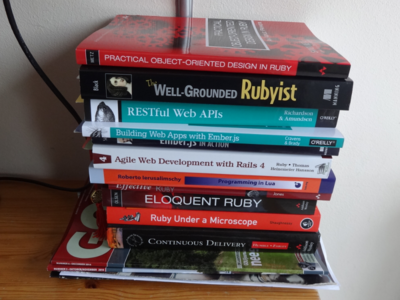
Right now I am reading a bunch of books simultaneously in my never-ending attempt to acquire infinite knowledge. Nine books all in a row, to be more precise. Depending on my mood at a given instant, I will jump from the one book to the other. Sometimes smack dab in the middle of a chapter, I will close the book I am currently reading and open up another book. Some reading sessions consist of switching books five or six times an hour. I suffer from an insecure feeling that perhaps I am not increasing my knowledge as productively as I should. That what I am reading at the moment is not valuable enough in the sense that I am suffering an acute shortage by not improving my life sufficiently and quickly enough! This can be very frustrating. The innocent pleasures of reading suffer in that regard which is ironic to say the least. There is this endless source of interesting information out there, and there is absolutely no way I can absorb it all in the limited span of my lifetime. By nature I have an addictive tendency, a proclivity which bends me in fixations. Especially when it is in any way remotely related to the esoteric acquisition of knowledge. So why bother in the first place? Infinite knowledge is preferable, of course. Unfortunately one cannot attain this by reading, even if one could have enough time to read every single book in every possible language that has ever been written in the history of civilization. In order to give my readers a hint of how far along this reading adventure I have come, here is a list of books that currently lie on the reading table next to my bedside. The order is from bottom to top, or since I am by nature symetrical and neat, from the widest (usually the thickest, but now always) in decreasing order:

  • Programming Perl, Third Edition by Larry Wall et al.
  • Javascript, The Definitive Guide by David Flanagan.
  • The 7 Habits of Highly Effective People by Stephen R. Covey.
  • Essential CSS & DHTML for Web Professionals by Dan Livingston.
  • Web Design in a Nutshell by Jennifer Niederst.
  • Cascading Style Sheets 2.0 Programmer's Reference by Eric A. Meyer.
  • A Beautiful Mind by Sylvia Nasar.
  • The Power of Now by Eckhart Tolle.
  • Caesar by Colleen McCullough.

As you can see from the list I am pretty much obsessed with Web-related stuff at the moment. However, I try my best to balance this with other non-Web stuff. Reading one book at a time would probably be much more efficient, but I am too impatient. For the sake of simplicity, let's just say that I am about half-way along the pursuit of infinite knowledge.

 | Books | 0 Comments

Now I have been reading this book by Eckhart Tolle called "The Power of Now." One of those self-improvement books where this so-called spiritual sage explains to us lost souls how we need to concentrate our lives better on living in the Now. The Now. I started enthusiastic enough with an open mind, but now half a year later I am struggling to complete the very last chapter. The meaning of surrender. This stuff is getting pretty repetitive, warped towards appealing to a modern society. Now now now and now. If I hear that word Now one more time I am going to become crazy. Even crazier than I am already, if that is possible. There are alot of good and interesting ideas, I have to admit it, but nothing really original that was not already figured out thousands of years ago. Back then and Now. One thing I did like is the following quote. Have alook at it Now:

"Surrender is the simple but profound wisdom of yielding to rather than opposing the flow of life."

"The only place where you can experience the flow of life is Now, so to surrender is to accept the present moment unconditionally and without reservation."

Now. Okay, so I am being boringly wishy-washy here. On the one hand I can get overly critical about some book, and then on the other hand I go out of my way to put down a quotation from the very same book. What is really happening Now?

Now.

Now. Check it out for yourself by visiting the Excerpts from The Power of Now page. You too can become inspired and learn to live in the Now.

Now. When I was a teenager and thought I knew everything there was to know in life, one of my favorite sayings was "Flow with the stream." Funny how I still believe that and lead my life according to what some smart-ass kid used to say with so much confidence way back in the Seventies. Now.

 | Books | 0 Comments

I cannot believe that the author Ray Bradbury has recently turned 80. Seems like just yesterday that as a young reader I was so overly impressed by his books "The Illustrated Man" and "The Martian Chronicles". I think I was around 12 years old. Time flies, doesn't it? I wonder what life will be like at age eighty.

Recent Assets

  • Keizersgracht.jpg
  • Hole-17.jpg
  • brandnetels.jpg
  • view-hotel-balcony.jpg
  • near-balestrand-sognefjord.jpg
  • roughlong.gif
  • HB3-champs.png
  • chip-shot.jpg
  • rotterdam_blitz2.jpg
  • Rotterdam_blitz.jpg
  • edgerton_golf_swing.jpg
  • webcam-rightside-up.jpg

Recent Comments

OpenID accepted here Learn more about OpenID

Information

This personal weblog was started way back on July 21, 2001 which means that it is 7-21-2001 old.

So far this blog contains no less than 1837 entries and as many as 1821 comments.

I graduated from Stanford 6-5-1979 ago.

I first met Thea 6-14-1980 ago.

Believe it or not but I am 10-11-1957 young.